Table of Contents
ToggleWeeds aren’t just an eyesore, they’re thieves. They steal water, nutrients, and sunlight from the grass you’ve invested in, turning a lush lawn into a patchy mess. Whether you’re dealing with a handful of dandelions or an invasion of crabgrass, the good news is that killing weeds doesn’t require professional help or a chemical arsenal. This guide walks you through five battle-tested methods to reclaim your lawn, from elbow-grease manual removal to strategic prevention that stops weeds before they germinate. You’ll learn which approach fits your situation, what tools you actually need, and how to avoid the prep-work mistakes that doom most DIY weed control efforts.
Key Takeaways
- Act early when you spot the first few weeds, before they flower and seed—a single dandelion can produce 15,000 seeds that plague your lawn for years.
- Kill weeds in lawn using manual removal for small infestations by hand-pulling in moist soil with a weeding fork, ensuring you remove 90% of the root system to prevent regrowth.
- Selective herbicides like 2,4-D target broadleaf weeds while leaving grass unharmed, but timing, product selection, and proper application are critical to success.
- A healthy, dense lawn is your best defense—maintain proper mowing height (2.5–3.5 inches), water deeply but infrequently, and apply pre-emergent herbicide in early spring to prevent weeds before they germinate.
- Natural methods like boiling water and vinegar work for small problem areas, but large infestations often require combining multiple approaches or selective chemical control for reliable results.
Why Weeds Take Over Your Lawn and When to Act
Weeds thrive where grass is weak. Thin turf, compacted soil, poor drainage, and nutrient deficiencies create a welcome mat for opportunistic plants like dandelions, chickweed, and crabgrass. Most homeowners discover their weed problem in spring or early summer, exactly when weeds are actively seeding and spreading.
Timing matters. Early intervention, before weeds flower and set seed, saves you months of fighting. A single mature dandelion can produce 15,000 seeds. Once those seeds are in the soil, you’re fighting a losing battle for years. Act when you spot the first few weeds, while they’re still isolated and vulnerable.
Understanding your enemy also matters. Annual weeds (like crabgrass) grow for one season then die, but they drop thousands of seeds first. Perennial weeds (like dandelions and plantain) return year after year from their root systems. Knowing which type you’re battling determines whether you pull, spray, or prevent.
Manual Removal: The DIY Approach for Small Problem Areas
Hand-pulling works for small infestations and is the safest option if you want zero chemicals on your lawn. The trick is timing and technique. Pull weeds early morning or right after rain when soil is moist, dry soil won’t release roots cleanly, and you’ll snap stems off below ground, leaving the root to regrow.
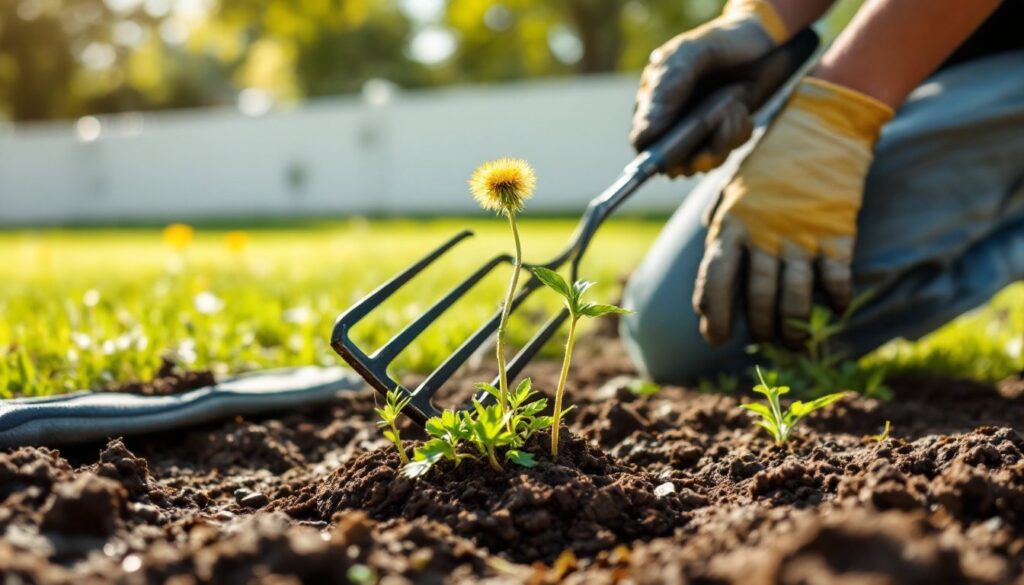
What you’ll need: A weeding fork or dandelion digger (sometimes called a Cape Cod weeder), a kneeling pad, and work gloves. A weeding fork has long tines that slide alongside the weed root, allowing you to lever the entire plant out in one motion. Cheap forks fold or bend: invest in one with a reinforced steel shaft if you’re tackling more than a dozen weeds.
The process: Kneel next to the weed so you’re at a low angle. Position the fork tines on either side of the weed stem, about 4–6 inches from the base. Push down slowly, tilting the handle back to lift the root up. Pull the weed out with your hands once it’s loosened. Fill the hole with soil so it doesn’t become a pocket for new seeds.
For larger perennial weeds with deep taproots (dandelions, thistles), go deeper. You need to remove at least 90% of the root system: any fragment left behind will regenerate. Manual removal works best for small problem areas, 5 to 10 scattered weeds. Beyond that, you’ll burn out before making real progress.
Herbicides: Chemical Solutions for Stubborn Weeds
Selective Herbicides for Targeted Control
Selective herbicides kill broadleaf weeds (dandelions, clover, plantain) while leaving grass unharmed. They’re formulated to target the plant’s physiology, broadleaf weeds have different leaf structures and growth patterns than grass, so the herbicide recognizes and attacks the enemy without collateral damage.
Common active ingredients include 2,4-D (2,4-dichlorophenoxyacetic acid), dicamba, and MCPA. Many lawn products combine two or three of these to cover a broader range of problem weeds. Read the label carefully, different weeds require different products. Dandelions may respond to 2,4-D alone, but ground ivy or creeping Charlie often need dicamba or a combination product.
Application: Spray on a calm, warm day (60–75°F is ideal) when weeds are actively growing. Wet the entire leaf surface but don’t oversaturate. Results take 1–3 weeks as the herbicide translocates through the plant. Don’t mow for 2–3 days after spraying. Wear gloves and eye protection even though selective herbicides are considered lower toxicity.
Non-Selective Herbicides for Maximum Impact
Non-selective herbicides, most famously glyphosate (Roundup), kill almost everything they touch, grass included. Use them only on weeds growing in hardscapes, cracks, or driveway edges where grass isn’t present. Or use a brush killer with a higher concentration for thicker brush and woody stems.
If you need to kill weeds in a lawn area with heavy mixed infestations, consider spot-spraying: apply non-selective herbicide with a sprayer or sponge brush directly to weed leaves, being careful not to drip on nearby grass. Some gardeners use a spray shield or cardboard sleeve to contain overspray. Results appear within days, but regrowth can occur if root fragments remain.
Always follow label directions exactly. Studies on weed control methods show that most herbicide failures stem from incorrect timing, wrong product choice, or improper application, not from the product itself failing. Store herbicides in original containers, out of reach of children and pets, and dispose of empty containers according to local hazardous waste guidelines.
Natural and Organic Weed Control Methods
If you prefer avoiding synthetic chemicals, several natural methods work, though they often require more time and elbow grease.
Boiling water: Pour directly on weeds on hardscapes or driveways. It kills foliage and upper roots instantly but won’t prevent regrowth from deep root fragments. Use it for small clusters between pavers or in gravel areas, not across your whole lawn.
Acetic acid (vinegar-based products): 20% acetic acid products (stronger than kitchen vinegar) burn down foliage but don’t kill roots consistently. Spray on a sunny day for best results. Repeated applications may eventually exhaust the root, but expect 3–4 treatments over several weeks. Vinegar spray can harm nearby plants and isn’t selective, so target only problem areas.
Corn gluten meal: A pre-emergent that prevents weed seeds from germinating. It’s applied in spring (March–April in most zones) before weed seeds are expected to sprout. Organic weed control guides recommend this for prevention rather than elimination of existing weeds. It’s slow-acting and works best as part of a multi-year strategy.
Flame weeding: A propane torch quickly passes heat over weed foliage, rupturing cell walls. It works on hardscapes and between pavers but isn’t practical for widespread lawn coverage and poses fire risk in dry conditions. Use only with extreme caution on dry days, never near structures.
Natural methods suit prevention and small infestations. For large areas or tough perennial weeds, they’re often insufficient without combining multiple approaches.
Prevention: Building a Healthier Lawn to Stop Weeds Before They Start
The best weed killer is a healthy lawn. Dense, vigorous grass crowds out weeds by competition, sunlight, water, and nutrients go to the grass you want, not invaders.
Mow at the right height. Keep grass at 2.5–3.5 inches depending on your grass type (cool-season grasses prefer the higher end). Taller grass shades soil, keeping it cooler and reducing weed seed germination. Most homeowners mow too short, which weakens grass and invites weeds.
Water deeply but infrequently. Shallow daily watering encourages shallow roots and activates dormant weed seeds in the top layer of soil. Water 1–1.5 inches per week in one or two sessions, allowing water to penetrate 6–8 inches. This strengthens grass roots and keeps the seed bed drier.
Fertilize appropriately. Nutrient-deficient lawns thin out, creating bare spots where weeds establish. Conduct a soil test (contact your local extension office) to determine exact needs, then apply a balanced fertilizer in spring and fall. Avoid excessive nitrogen in summer, which can cause disease and weak growth.
Aerate and overseed thin areas. Core aeration loosens compacted soil, improving drainage and root penetration. Overseed bare spots with grass seed matching your existing lawn variety. New grass establishes quickly in disturbed soil, outcompeting weed seedlings.
Use pre-emergent in spring. Step-by-step weed control strategies recommend applying pre-emergent herbicide (granular or liquid) in early spring before soil temperature reaches 60°F consistently, usually late February to early March in most zones. This blocks crabgrass and other annual weed seeds from sprouting. Timing is critical: apply too early and it breaks down: too late and seeds have already germinated.
Prevention takes patience. Results compound over a season or two, but you’ll spend far less time and money fighting weeds if you build a thick, healthy turf from the start.