Table of Contents
ToggleIf you’ve ever watched someone wrestle with a stand mixer bowl or scrape batter from the sides just to add one more ingredient, you know there’s room for improvement in mixer design. The KitchenAid tilt-head mixer solves that problem with a simple but effective approach: instead of locking the bowl in place, the head tilts back, giving you easy access to everything without wrestling with components. For home bakers, pastry enthusiasts, and serious cooks, understanding why this design matters can change how you approach kitchen projects. Whether you’re mixing heavy dough, whipping cream, or folding delicate ingredients, the tilt-head mechanism offers practical advantages that make the difference between a frustrating chore and smooth, efficient work.
Key Takeaways
- A KitchenAid tilt-head mixer offers superior convenience by tilting the head backward to expose the bowl, allowing you to add ingredients and scrape sides without removing any components.
- The tilt-head design is mechanically simple, relying on a spring-loaded latch instead of motors or electronics, which means fewer parts to break and reliable performance for years.
- Tilt-head mixers typically come in 5-quart and 6-quart capacities with power ratings from 275 to 500+ watts, making them ideal for home bakers mixing one or two batches at a time.
- The compact profile of tilt-head KitchenAid mixers makes them perfect for smaller kitchens and tight counter space, while their lower cost compared to bowl-lift models adds to their value.
- Maintenance is minimal—simply hand-wash the bowl and attachments after each use, wipe the exterior, and the spring-loaded mechanism requires no lubrication under normal use.
- For home kitchens, tilt-head mixers win on practicality and ease of access, making everyday baking tasks like mixing dough, whipping cream, or making cookies smooth and efficient.
What Is a Tilt-Head KitchenAid Mixer?
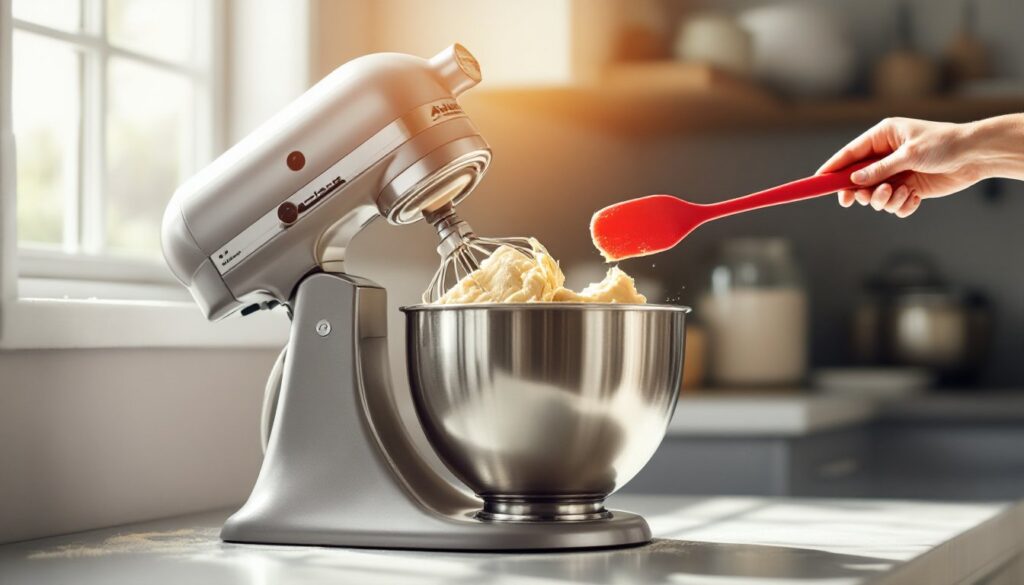
A KitchenAid tilt-head mixer is a countertop stand mixer where the mixing head, the part holding the beaters, whip, and dough hook, tilts backward on a hinge, pivoting upward to expose the bowl beneath. Unlike bowl-lift models, which require you to lift the entire bowl out, the tilt-head design keeps the bowl stationary while you simply tilt the head back and away from you.
This design has been a cornerstone of KitchenAid’s mixer lineup for decades. The mechanism is mechanical and straightforward: a spring-loaded latch holds the head forward during mixing, and releasing that latch lets gravity and the spring handle the tilt motion. No motors, no electricity needed for the tilt, it’s pure engineering simplicity. For everyday home cooks, this means fewer parts to break and a mixer that functions reliably year after year.
The tilt-head mixer is typically more compact than bowl-lift models, making it easier to fit on crowded kitchen counters or store in a cabinet if needed. The motor sits lower, and the overall profile is slimmer, which many home bakers appreciate, especially in smaller kitchens.
Key Features That Define the Tilt-Head Design
Access and Convenience
The biggest win with a tilt-head mixer is simple access. When the head tilts back, you can easily add ingredients without removing anything, scrape the sides with a rubber spatula without awkward angles, or swap attachments in seconds. There’s no bowl to lift out or catch on the mixer frame, you just tilt, reach, and go.
This becomes especially valuable when you’re making something like cookie dough where you’re adding ingredients incrementally, or when you need to hand-mix the final ingredients into a batch. The tilt-head also makes cleaning simpler: you can tilt the head back to access the bowl directly, rinse it without moving the mixer, and reposition everything in less time than a bowl-lift requires.
The mechanism itself is durable. Since it relies on a spring and latch rather than electronic sensors or motors, there’s less to wear out or malfunction. KitchenAid’s tilt-head mechanism is engineered to stay smooth for thousands of tilt cycles.
Capacity and Power Options
Tilt-head mixers typically come in 5-quart and 6-quart capacities, with the 5-quart being the standard for most home kitchens. A 5-quart bowl holds enough dough for two dozen cookies, a couple of loaves of bread, or several batches of cake batter.
Power ratings vary by model. Entry-level tilt-head mixers run around 275 watts, while higher-end versions reach 500+ watts. More wattage matters when you’re mixing stiff doughs like bread or pasta dough, a less powerful motor will struggle or stall, while a stronger motor handles the load without straining. The KitchenAid Artisan Plus model, for example, includes a more robust motor than the standard Artisan, making it better for frequent bread baking or heavy-duty use.
Three standard attachments come with every tilt-head mixer: the flat mixing paddle for general mixing, the C-shaped dough hook for kneading, and the wire whip for whipping cream or egg whites. Some models offer optional accessories like pasta extruders or vegetable shredders, though these are add-ons.
How to Use and Maintain Your Tilt-Head Mixer
Using a tilt-head mixer is intuitive, but a few habits ensure longevity and safety. Always secure the head in the forward position before turning on the motor, never operate with the head tilted back. Load ingredients into the stationary bowl, insert your chosen attachment (dough hook, paddle, or whip), then lower the head to engage with the attachment.
Start on the lowest speed, especially with dry ingredients or stiff doughs, to prevent splashing or overstressing the motor. Once ingredients begin to combine, gradually increase speed. The mixer will handle the work from there: you’re mainly monitoring progress and letting the machine do its job.
To tilt the head back, release the tilt lever (usually a simple push-button or latch on the front), and the spring-loaded mechanism will tilt the head backward. Add more ingredients, scrape the sides if needed, then re-engage the lever and return the head to its operating position. The tilt-back motion takes maybe two seconds, and the whole process feels natural after the first or second time.
Maintenance is minimal. After each use, unplug the mixer and hand-wash the bowl and attachments. Wipe down the exterior with a damp cloth: don’t submerge the motor housing. Over time, you may notice the attachment connection point gets a little sticky flour residue, a quick wipe with a damp cloth clears that. The tilt mechanism itself doesn’t require lubrication under normal use. If the tilt becomes sticky or difficult after years of use, contact KitchenAid support: it’s typically a minor service.
Tilt-Head vs. Bowl-Lift Mixers: Which Is Right for You?
The choice between tilt-head and bowl-lift comes down to how you mix and what matters most in your workflow. A bowl-lift mixer has a stationary motor head: you raise and lower the entire bowl using a lever on the side. The bowl locks into position during mixing, offering very stable operation for large batches. Bowl-lift models typically start at 6 quarts and go up to 8-quart commercial sizes, so if you’re baking for a crowd or running a small business, that capacity matters.
Bowl-lift mixers are heavier, larger, and take up more counter space. They’re also more complex mechanically, with more parts that can eventually wear or fail. But they excel at repetitive production, if you’re mixing 5 batches of bread dough back-to-back, the locked bowl is reassuring.
Tilt-head mixers are the opposite: compact, simple, easier to access during a mix, and lighter to handle. If you’re a home baker mixing one or two batches at a time and appreciate not having to swap out bowls, tilt-head is your machine. They’re also generally less expensive, sometimes by $100 or more. Recent KitchenAid innovations, like the Artisan Plus features reviewed on Good Housekeeping, highlight the durability and improvements in tilt-head models, making them a solid choice for serious home use.
For most home kitchens, tilt-head wins on practicality. You’ll use it more often, enjoy the convenience, and appreciate the simplicity when something eventually needs attention.
Conclusion
The KitchenAid tilt-head mixer is a workhorse that’s earned its place in home kitchens for good reason. The tilt mechanism is simple, reliable, and removes friction from everyday baking tasks. If you spend time mixing dough, whipping cream, or making cookies regularly, the ease of access and straightforward operation will feel like a small upgrade that pays dividends. It’s the kind of appliance that doesn’t demand attention, it just works when you need it, year after year.