Table of Contents
ToggleTired of waiting for summer to enjoy fresh tomatoes straight from your garden? Indoor tomato gardening is your answer. Whether you’re working with a windowsill, a basement corner, or a dedicated shelf, growing tomatoes indoors lets you harvest ripe, flavorful fruit year-round, no backyard required. This isn’t some exotic technique reserved for greenhouses: thousands of homeowners are successfully growing tomatoes inside their homes right now. In this guide, we’ll walk you through everything from choosing the right varieties to setting up the lighting and care routine that’ll keep your plants thriving through every season.
Key Takeaways
- Indoor tomato plants eliminate weather dependency and pest pressure, allowing you to grow fresh tomatoes year-round regardless of outdoor conditions or available yard space.
- Dwarf and compact tomato varieties like ‘Micro Tom’ and ‘Tiny Tim’ are ideal for indoor growing, maturing in 50–70 days and thriving in containers as small as 5 gallons.
- LED grow lights are essential for indoor tomato success—position them 6–12 inches above plants and run them 14–18 hours daily to provide the 14–18 hours of light tomatoes need for flowering and fruiting.
- Consistent daily care including regular watering (when the top inch of soil feels dry), biweekly fertilizing with phosphorus-rich formulas, and proper air circulation through a small fan prevents common indoor growing failures.
- Hand-pollination or vibration from an oscillating fan is necessary indoors since natural pollinators are absent—gently brush flower centers with a brush or run your fan at full speed during flowering to ensure fruit sets.
Why Indoor Tomato Gardening Works for Home Spaces
Indoor tomato gardening solves a real problem: most of us don’t have ideal outdoor growing conditions. Maybe your climate is too cold, your backyard gets shadowed by neighbors’ trees, or you live in an apartment with no yard at all. Growing tomatoes indoors eliminates weather dependency, pest pressure, and the need for a sprawling garden.
Indoor plants also give you precise control. You decide the temperature (tomatoes prefer 65–75°F during the day), humidity levels, and exactly when they get light. This consistency leads to more reliable yields and fewer crop failures. A windowsill or grow shelf becomes a miniature farm operating on your schedule.
There’s a practical side too: you’ll notice problems faster with indoor plants. Early leaf yellowing, pest infestations, or nutrient deficiencies become obvious when your tomatoes are arm’s reach away, not twenty feet out in the yard. Catch issues early, and you’re usually home free. Plus, you’re not fighting nature’s seasonal clock, you can start seeds in January for spring harvests, then begin another crop in late summer.
Choosing the Right Tomato Varieties for Indoor Growing
Not every tomato thrives indoors. Determinate varieties (bush types that grow to a fixed size and fruit all at once) work better than indeterminate varieties (which sprawl and keep producing all season). That said, some indeterminate varieties, like cherry tomatoes and smaller slicing types, will still produce well indoors if you’ve got the vertical space and are willing to prune.
Look for varieties labeled dwarf, compact, patio, or container types. These won’t outgrow your indoor space in a month. Cherry and grape tomatoes are usually your safest bet: they mature faster, set fruit readily indoors, and tolerate lower light better than large beefsteak types. Some tried-and-tested choices include ‘Tiny Tim,’ ‘Tumbling Tom,’ ‘Micro Tom,’ and ‘Bush Early Girl.’
Maturity matters too. Choose varieties that mature in 50–70 days rather than 80+ days if you can. Faster maturity means less time under lights and lower electricity costs. Check seed packets or online descriptions for “days to maturity”, this number is your roadmap.
Compact and Dwarf Varieties
Dwarf varieties are practically built for indoor gardening. Most max out at 12–24 inches tall, requiring just a small pot and modest shelf space. ‘Micro Tom’ stays under 12 inches, produces golf-ball-sized fruit, and thrives on a sunny windowsill. ‘Patio’ types are similarly compact, with determinate growth that keeps them manageable.
Compact doesn’t mean low-yield. A single ‘Tiny Tim’ plant can produce dozens of fruits if you’re feeding and lighting it properly. The tradeoff is fruit size, expect smaller tomatoes, but flavor-wise, they’re often superior to larger varieties. Dwarf varieties also tolerate crowding better, so if space is tight, you can cluster a few pots together. Just ensure air circulation between plants to reduce fungal issues.
Setting Up Your Indoor Tomato Growing Space
Your growing space doesn’t need to be fancy, but it does need the right fundamentals: light, containers, and airflow. A sunny south-facing windowsill works for one or two plants, but most indoor growers quickly realize they need supplemental light to prevent leggy, weak growth.
Start with containers at least 5 gallons (10–12 inches deep) for dwarf varieties and 7–10 gallons for larger compact types. Bigger containers hold more soil and reduce watering frequency, a real advantage in winter when soil dries slower. Drill drainage holes if there aren’t any. Use a high-quality potting mix, not garden soil, which compacts and traps moisture indoors.
Air circulation is non-negotiable. Stagnant air invites powdery mildew and fungal issues. A small oscillating fan on low speed, running 4–6 hours daily, keeps air moving and strengthens plant stems (wind movement naturally strengthens stems). Position it so it doesn’t blast the plants directly.
Temperature control sounds complicated but isn’t. Keep your growing area between 65–75°F during the day and no lower than 55°F at night. Most homes naturally sit in this range: if your basement grows get chilly, move the pots up on a shelf where it’s warmer.
Lighting Requirements for Healthy Growth
Here’s the hard truth: most windowsills don’t provide enough light for tomatoes to fruit reliably. Even a south-facing window delivers only 2–3 hours of direct sun in winter. Tomatoes need 14–18 hours of light daily and strong intensity to set flowers and fruit. This is where grow lights come in.
LED grow lights are your best investment. They’re energy-efficient, don’t run hot, and deliver the spectrum tomatoes need. Position lights 6–12 inches above plants, check your light’s manual for the recommended height. A simple shop light fixture with two standard T8 or T12 LED tubes ($30–50) works fine for 1–2 pots. If you’re getting serious, invest in a mid-range full-spectrum LED panel ($100–200): it’s overkill for one plant but handles 4–6 easily.
Run lights 14–18 hours daily. Use a basic timer (under $10) to automate this. Set it to turn on at 6 a.m. and off at 8 p.m., most homes won’t even notice the light or energy draw. Combine window light with grow lights for best results. Position grow lights so they cover the top of the plant, not shining from the side: tomatoes direct most growth upward.
Essential Care and Maintenance Tasks
Consistency beats intensity with indoor tomatoes. Neglect them for a week, and you’ll see wilting, nutrient issues, and a stalled season. But show up daily, even for 10 minutes, and they’ll thrive.
Start seedlings indoors 6–8 weeks before your intended planting date (for continuous indoor harvests, stagger starts 4–6 weeks apart). Use seed-starting mix, keep soil warm (70–75°F helps germination), and ensure seedlings get bright light immediately once they sprout, no leggy stretching allowed. As soon as two true leaves appear, move seedlings under grow lights.
Transplanting happens when roots fill the starter pot. Gently move seedlings to 5-gallon containers with indoor potting mix. Bury them up to their first true leaves: they’ll root along the buried stem and develop a stronger base. This one step makes a huge difference in plant vigor.
Ongoing feeding matters because indoor potting mix has limited nutrients. Feed every 2 weeks with a balanced liquid fertilizer (10-10-10 or similar) once plants reach 6 inches tall. Switch to a higher-phosphorus formula (10-30-20) once flowers appear: phosphorus drives fruiting. Follow package instructions for dilution rates.
Staking and pruning keep things manageable. Indeterminate varieties benefit from a tomato cage or string support tied to overhead structure. Prune lower leaves once fruit sets to improve air circulation and reduce disease pressure. Pinch off “suckers” (shoots growing between the main stem and branches) on indeterminate types to direct energy into fewer, larger fruits.
Watering, Feeding, and Pollination Techniques
Watering is critical and often done wrong. Indoor air is drier, and potting mix loses moisture fast under grow lights. Check soil moisture by touch every day: water deeply when the top inch feels dry. Don’t let soil dry completely or stay soggy, that middle ground is the sweet spot. Most indoor growers water 2–3 times weekly in summer, 1–2 times in winter.
Use room-temperature water if possible. Cold water shocks roots and slows growth. A simple watering can lets you control the flow and avoid splashing foliage (wet leaves invite mildew). Some growers switch to a drip irrigation system once they’ve got multiple pots: it’s more reliable and saves time.
Fertilizer consistency is key. Set a calendar reminder for feeding day, mark it every other week. Tomatoes are heavy feeders, especially once fruiting starts. Dilute liquid fertilizer as directed and apply to soil, not foliage. If leaves yellow between feedings, bump up frequency slightly, but don’t overdose: excess nitrogen delays flowering.
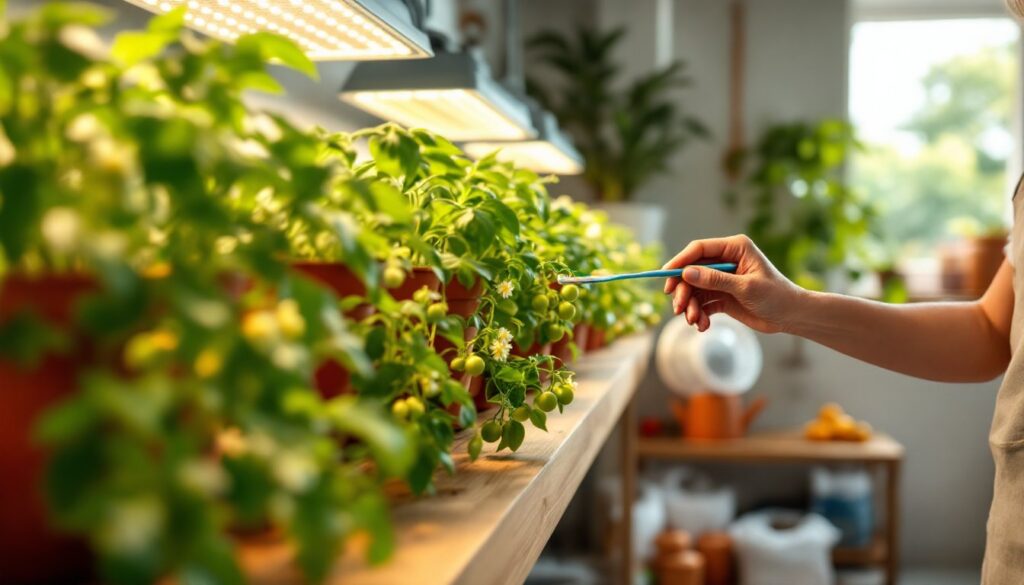
Pollination is the sneaky challenge indoors. Outdoors, bees and wind handle it. Inside, there’s no wind or pollinators, so flowers often drop without setting fruit. Hand-pollination is simple: use a small brush (even a clean toothbrush works) to tickle flower centers every morning or afternoon when flowers open. Alternatively, run your oscillating fan at full speed for 30 minutes daily when plants are flowering: the vibration mimics natural wind pollination.
Some growers tap flowering branches gently with a pencil or fingertip to release pollen. It’s fast, 30 seconds per plant, and works well once you’ve got the rhythm. Do this once or twice during peak flowering, and you’ll see green tomatoes forming within days. Resources like those from Hunker on growing tomatoes indoors offer detailed visual guides for hand-pollination techniques if you want to dive deeper.